Landowners have rights after all? Who knew?

From New York State Town Law:


    1. Method of procedure. The town board shall provide for  the  manner  
  in  which  such  regulations,
  restrictions   and  the  boundaries  of  such  districts  including  any
  amendments  thereto  shall  be  determined,  established  and  enforced.
  However,  no  such  regulations, restrictions or boundaries shall become
  effective until after a public hearing in relation thereto, at which the
  public shall have an opportunity to be heard. At least ten days'  notice
  of  the  time and place of such hearing shall be published in a paper of
  general circulation in such town.
    Every zoning ordinance and  every  amendment  to  a  zoning  ordinance
  (excluding  any  map  incorporated  therein)  adopted  pursuant  to  the
  provisions of this chapter shall be entered in the minutes of  the  town
  board;  such  minutes  shall  describe  and  refer to any map adopted in
  connection with such zoning ordinance or amendment and a  copy,  summary
  or abstract thereof (exclusive of any map incorporated therein) shall be
  published  once in a newspaper published in the town, if any, or in such
  newspaper published in the county in which  such  town  may  be  located
  having  a circulation in such town, as the town board may designate, and
  affidavits of the publication thereof  shall  be  filed  with  the  town
  clerk. Such ordinance shall take effect ten days after such publication,
  but  such  ordinance or amendment shall take effect from the date of its
  service as against a person  served  personally  with  a  copy  thereof,
  certified  by  the  town clerk under the corporate seal of the town; and
  showing the date of its passage and entry in the minutes.    Every  town
  clerk  shall  maintain  a  separate  file or filing cabinet for each and
  every map adopted in connection with a zoning ordinance or amendment and
  shall file therein every such map hereafter adopted; said file or filing
  cabinet to be available at any time during regular  business  hours  for
  public inspection.
   
    2.  Service  of written notice. At least ten days prior to the date of
  the  public  hearing,  written  notice  of  any  proposed   regulations,
  restrictions  or  boundaries of such districts, including any amendments
  thereto, affecting property within five hundred feet  of  the  following
  shall  be  served  personally or by mail by the town upon each person or
  persons listed below:
    (a) The property of the housing authority erecting or owning a housing
  project authorized under the public  housing  law;  upon  the  executive
  director  of  such  housing authority and the chief executive officer of
  the municipality providing financial assistance thereto.
    (b) The boundary of a city, village or town; upon the clerk thereof.
    (c) The boundary  of  a  county;  upon  the  clerk  of  the  board  of
  supervisors or other person performing like duties.
    (d)  The  boundary of a state park or parkway; upon the regional state
  park commission having jurisdiction over such state park or parkway.
   
    3. Additional requirements.  The  procedural  requirements  set  forth
  herein  shall  be  in  addition to the requirements of the provisions of
  sections two hundred thirty-nine-l and two hundred thirty-nine-m of  the
  general  municipal  law relating to review by a county planning board or
  agency or  regional  planning  council;  the  provisions  of  the  state
  environmental   quality   review   act   under   article  eight  of  the
  environmental conservation law and its  implementing  regulations  which
  are  codified  in  title  six part six hundred seventeen of the New York
  codes, rules and regulations and any other general laws relating to land
  use and any amendments thereto.
   
    4. Public hearing. The public, including those served notice  pursuant
  to  subdivision  two  of  this  section, shall have an opportunity to be
  heard at the public hearing. Those parties set forth in paragraphs  (a),
  (b),  (c) and (d) of subdivision two of this section, however, shall not
  have the right of review by a court as hereinafter provided.

 
    1. Such regulations, restrictions and boundaries may
  from time to time be amended. Such amendment  shall  be  effected  by  a
  simple  majority  vote of the town board, except that any such amendment
  shall require the approval of at least three-fourths of the  members  of
  the  town  board in the event such amendment is the subject of a written
  protest, presented to the town board and signed by:
    (a) the owners of twenty percent or more of the area of land  included
  in such proposed change; or
    (b)  the  owners  of  twenty  percent  or  more  of  the  area of land
  immediately adjacent to that land  included  in  such  proposed  change,
  extending one hundred feet therefrom; or
    (c)  the owners of twenty percent or more of the area of land directly
  opposite thereto, extending one hundred feet from the street frontage of
  such opposite land.
    The provisions of the previous section relative to public hearings and
  official notice shall apply equally to all proposed amendments.
   
    2.  Amendments  made  to  any  zoning  ordinance  (excluding  any  map
  incorporated therein) adopted pursuant to the provisions of this chapter
  shall  be  entered  in the minutes of the town board; such minutes shall
  describe and refer to any map adopted in connection  with  such  change,
  amendment  or  supplement  and  a  copy,  summary  or  abstract  thereof
  (exclusive of any map incorporated therein) shall be published once in a
  newspaper published in the town, if any, or in such newspaper  published
  in  the county in which such town may be located having a circulation in
  such town, as the town  board  may  designate,  and  affidavits  of  the
  publication  thereof  shall be filed with the town clerk. Such ordinance
  shall take effect upon filing in the office of  the  town  clerk.  Every
  town  clerk shall maintain every map adopted in connection with a zoning
  ordinance or amendment.
 
At EID:
 
Section 265 of the Town Law can be a powerful tool to combat single-minded political opportunists who seek election for the purpose of imposing their particular ideologies and political will upon others regardless of Constitutional protections and property rights.  Landowner groups in towns considering bans need to be aware of this option and be ready to move... 
 

Errors in Myers’ Marcellus Shale Groundwater Paper from Start to Finish

From Dr. Don Siegel, Syracuse University:


Last month, the journal of the National Ground Water Association published a paper by an environmental consultant in Nevada in which the proposition is put forth that the vertical transport of contaminants from the Marcellus Shale formation of southern New York to potable, near-surface aquifers is not only plausible, but likely – brought to us in as few as “three years,” he argues, and all because of hydraulic fracturing.
 
It’s an explosive thesis, to be sure – but one that’s also fatally flawed; very good news for those of us who actually live here in upstate New York. Predictably, and perhaps as designed, the paper generated a great deal of attention in the press after ProPublica first reported its conclusions on May 1. But as I attempt to explain below, the physical realities governing the hydrodynamic flow of fluids underground can’t be as Dr. Tom Myers, the report’s author, suggests. I say this as someone who has studied the specific hydrogeology of New York for over 30 years. I found a number of fundamental errors in Myers’s model when I gave it a first, cursory review....
 

Gas drillers wrangle over NY limitations, bans


ALBANY, N.Y. –  With all the restrictions in proposed state regulations and local bans, gas companies say about half of their lease holdings in the lucrative Marcellus Shale region in New York state will be off-limits or inaccessible to drilling if the state gives the green light to developers this year.
A coalition of environmental groups is pushing for a complete ban on shale gas drilling, but the industry and landowners hoping to lease to drillers are working to lift some of the restrictions and halt the movement toward local bans.
"Industry estimates that when you look at the cumulative effect of prohibitions and setbacks, 40 to 60 percent of their leasehold is effectively undevelopable," said Tom West, an Albany lawyer representing gas companies...


Inadmissible evidence

As part of DSEC's educational mission to present facts, we give you this..."I’ll Take Natural Gas Facts Over Hearsay Any Day."
 

Have you ever noticed when someone outside travels to Dimock, Pennsylvania, searching for truth, all he/she ever reports is hearsay? Take Carol Schoonmaker’s recent guest essay published on MPNNow.com titled Learn the Lessons of one Small Pennsylvania Town, which details her decision to separate fact from fiction. There’s just one problem with Carol’s heart felt trip, where are her facts? Below is my follow up essay submitted to the same paper: Learn the lessons from a little unbiased research — A Pennsylvania resident responds. In it, I clarify and correct some of Carol’s claims with first hand knowledge of the area and industry...


Read the rest. 
 

The EPA's role in NYS

First, some history...Mr. Armendariz at EPA ultimately resigned over his "crucifixion" remarks but he'll be back, somewhere—they always are. The back story is linked at One of Nine.


And we should be afraid, very afraid, of EPA.  At EID:
 

Recent revelations regarding the deliberate attempts by a regional EPA administrator to “crucify” the oil and gas industry raise troubling questions about EPA political agendas in other regions.  One of these is New York Region 2 out of New York City, which commented on New York’s Supplemental Generic Environmental Impact Statement (SGEIS) with a long list of complaints seemingly designed to undermine the New York Department of Environmental Conservation.  Our Rockefeller-funded anti-natural gas friend Walter Hang notes “EPA Region 2 submitted nearly twice as many pages of critical comments regarding the Revised Draft SGEIS than the original 2009 draft SGEIS”... 


Oh there's a feature and not a bug.


Read the whole thing.
 

Public support slips for steps to curb climate change

In USA Today:

From gas-mileage standards to tax breaks for windmills, public support for "green" energy measures to tackle global warming has dropped significantly in the past two years, particularly among Republicans, a new poll suggests.

Majorities still favor most such tax breaks or restrictions on industry, finds the Stanford University poll to be released today. It shows 65% support gas-mileage standards and 73% support tax breaks for wind and solar power. But just 43% support tax breaks for nuclear power, 26% support increasing gasoline taxes and 18% support hiking taxes on home electricity.
 
Overall, support for various steps to cut greenhouse gas emissions has dropped an average of 10 percentage points since 2010, from 72% to 62%, lead researcher Jon Krosnick says. "Most Americans (62%) still support industry taking steps aimed at cutting greenhouse gas emissions," Krosnick says, "but they hate the idea of consumer taxes to do it." His group's nationwide polls compared responses from 1,001 people in 2010 to 1,428 people this year....
 
And in NRO:
 
In recent months, major coalitions of big business/big labor/green lobbyists, formed to combat climate change, have begun unravel. What this portends for the future of the climate controversy is anyone’s guess, but one point is clear: The waning support for these groups is good news for jobs and sound policy.
 
Environmentalists founded these groups to camouflage the fact that their policies could be demonstrated as bad for the economy and job creation. Corporations and unions joined largely because cap-and-trade legislation and the push for “green jobs” seemed inevitable, and it was in their interest to work with environmentalists to shape climate policies.
 
But today, the climate-change headlines have been replaced by more immediate concerns over unemployment and foreclosures. As the economy took center stage, environmental groups manufactured a new threat to stir up their supporters and raise funds for their operations. This new target of their campaigns is hydraulic fracturing...


Farmers as "collateral damage"

An op-ed piece re: the Park Foundation that appeared recently in local newspapers—by Dan Fitzsimmons and Bob Williams of the Joint Landowners Coalition:


What has been missed in the debate about the Ithaca-based Park Foundation's advocacy against natural gas development is the object of their opposition. The true targets of the Park Foundation are the people in Marcellus Shale communities of upstate New York.
 
In March 2011, we met with Park Foundation leadership. We were on the hunt for foundations to support the important work of the Joint Landowners Coalition to identify best practices in natural gas development and arm landowners with the information they need to protect themselves and their land...

...Foundation officials explained that their wealthy patrons were reticent to allow their pristine land to be affected by drilling rigs. We replied by telling them we had thousands of farmers who shared the same affection for their land. We described how the farmers were at risk of losing it all to high taxes and costs hitting up against record low profits — and that these farmers wouldn't allow their farms to be developed unless drilling could be done safely. Noting that they understood the plight of farmers, they replied, "We are aware there will be collateral damage from stopping natural gas development."

Thousands of upstaters who toiled all of their lives, some handing down their large or small farms generation to generation, were viewed merely as "collateral damage"...

The irony: "Solyndra Not Dealing With Toxic Waste At Milpitas Facility"

At CBS San Francisco:


MILPITAS (CBS 5) — Three months ago, CBS 5 caught Solyndra tossing millions of dollars worth of brand new glass tubes used to make solar panels. Now the bankrupt solar firm, once touted as a symbol of green technology, may be trying to abandon toxic waste.
 
It’s a tedious process. Slowly but surely, the shattered remains of brand new solar panel tubes head to a recycling plant in Hayward.
 
Meanwhile the next phase of the company’s liquidation is under way. It involves getting rid of all the heavy metals left inside the building that were used to make the panels...
 
...the disposal process is going smoothly in Fremont, but what about nearby Milpitas? Solyndra leased a building on California Circle for the final assembly of its solar panels. But the cleanup at the leased building in Milpitas is in limbo, because Solyndra doesn’t want to pay...
 
...“Essentially it looks like they left a pretty big mess behind,” San Jose State Assistant Professor Dustin Mulvaney told CBS 5. Mulvaney has written a white paper (.pdf) on solar industry waste for the Silicon Valley Toxics Coalition...


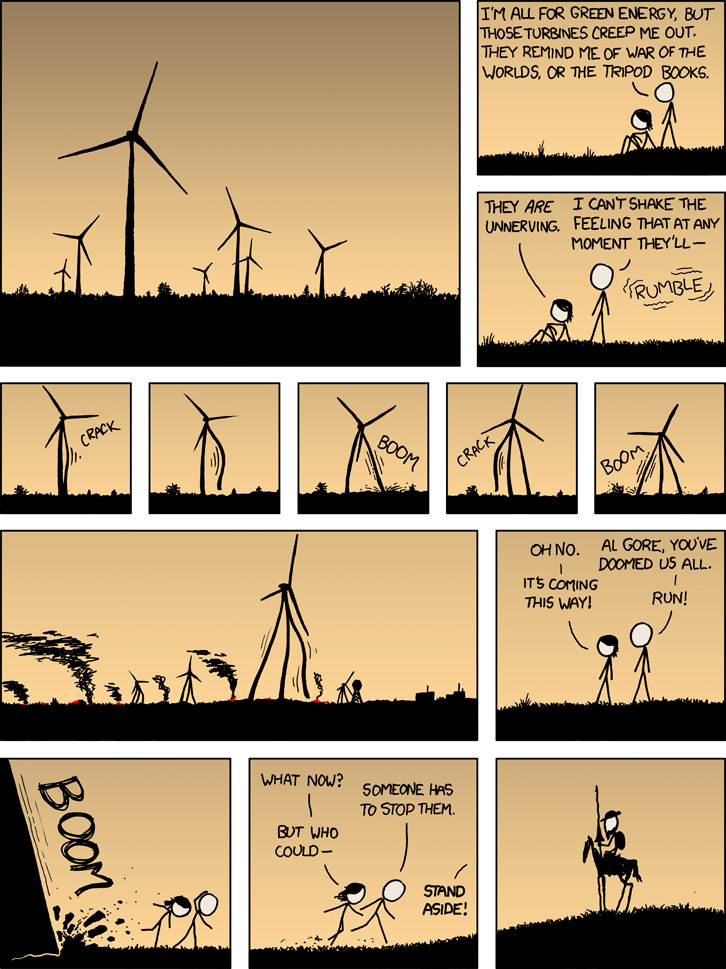
New source of climate warming: Wind farms

This is almost funny:
 

Great news for NIMBY activists that want public policy to follow the anthropogenic global-warming agenda but don’t want their vistas cluttered.  The wind farms that they support everywhere else but nearby themselves may be part of the problem...

...Wind power is already one of the worst options in the renewables market.  Wind is unreliable, and the unreliability of energy production causes numerous problems for distribution.  The manufacture and maintenance of the windmills requires a lot of energy, costs a lot of money, and creates a lot of waste, although perhaps not as much as Solyndra left behind.  The blades kill hundreds of thousands of birds a year already, and any expansion will make that destruction much worse.

Of course, the rise in temperature might be beneficial.  No one has shown that even if a warming period occurs naturally or artificially that the overall impact will be relentlessly negative...

Environmentalists...as opposed to enviromaniacs

At EID:

Typically, environmentalists have conservationist views – in general, they advocate for the preservation, restoration, or enhancement of the natural environment.  I view myself and many of the landowners I know as the true activist environmentalists and hard core conservationists...

...Why is it fine for wind and solar to kill protected animals? It’s not fine, as any true environmental conservationist would admit. And, that’s why natural gas is the energy I support. It creates more power per acre, while having less impact to the environment. It’s really a no brainer if your an environmentalist...

Read the whole thing.

Pages

Subscribe to Dryden Safe Energy Coalition RSS